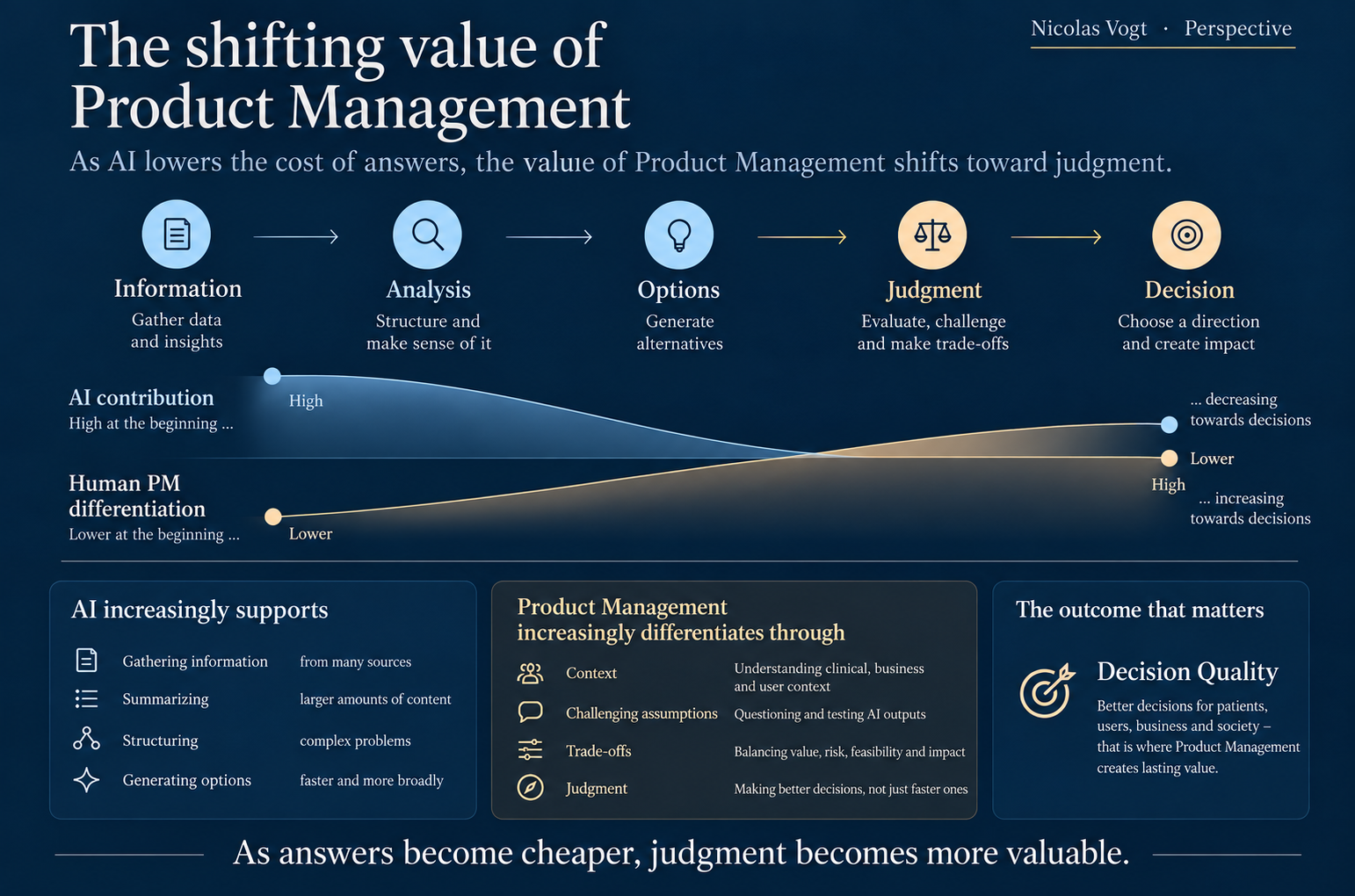
This perspective grew out of a discussion about what AI is actually changing in Product Management. The comments added an important dimension: if AI changes where Product Management creates value, it should eventually also change how we develop, evaluate and hire Product Managers.
AI is already changing a surprising amount of everyday Product Management. Research can be accelerated. Long discussions can be summarized in seconds. Requirements can be challenged, concepts can be drafted and alternative solutions can be generated with very little effort.
For someone who has spent years in Product Management, that is impressive. It is also slightly uncomfortable, because many activities that used to demonstrate professional competence are becoming cheap and abundant.
But I do not think this makes Product Management less relevant. I think it makes the real value of Product Management easier to see.
As AI lowers the cost of answers, the differentiator increasingly becomes the quality of judgment.
Answers are becoming abundant
For a long time, Product Managers created value partly by processing information. We gathered input from customers, development, sales and domain experts. We structured ambiguity, wrote concepts, prepared presentations and translated between groups that often used different language for the same problem.
Generative AI can support a large part of that work remarkably well. It can digest information, identify patterns, formulate hypotheses and produce a plausible first structure. Used well, it gives Product Managers more leverage and dramatically shortens the path from a blank page to something worth discussing.
That is a real productivity gain. But it also creates a new problem: a well-written answer is no longer strong evidence that the underlying thinking is good.
An AI-generated proposal can be coherent, polished and completely wrong for the situation. It may optimize the wrong problem, rely on an assumption nobody has challenged or overlook a constraint that is obvious only to someone who understands the domain.
The scarce capability becomes judgment
This is where I believe the role is shifting. When producing options becomes easier, selecting, challenging and combining them becomes more important.
Good Product Management has always required judgment. AI simply makes that requirement more visible. The Product Manager has to understand why one option is appropriate and another is not; which stakeholder need is decisive; which trade-off is acceptable; and which apparently elegant solution creates complexity somewhere else in the product or organization.
In Healthcare IT this becomes particularly obvious. A solution can look excellent from a software perspective and still fail clinically. A workflow can be efficient but create regulatory risk. A requirement can be completely legitimate for one profession while producing additional documentation burden for another. There is rarely one dimension to optimize.
AI can help us see more of those dimensions. It cannot take accountability for deciding between them.
The future PM advantage may not be knowing more. It may be making better decisions with the information AI provides.
Better questions matter more than faster answers
There is another consequence. If the first answer is available almost instantly, the quality of the question becomes more important.
What problem are we actually solving? Is the stated requirement the problem or merely one proposed solution? Which part of our reasoning is evidence and which part is assumption? Whose perspective is missing? What would have to be true for this option to work? And what happens downstream if we implement it?
These are not prompt-engineering questions. They are Product Management questions.
The most useful way I have found to work with AI is therefore not to ask it to replace thinking. It is to use it as an additional participant in the thinking process: generate alternatives, expose assumptions, challenge a concept, search for contradictions and force a clearer articulation of the decision.
That creates a much faster loop between exploration and critical review. The value is not that AI gives me the answer. The value is that I can interrogate the problem more thoroughly before I make a decision.
Context becomes a differentiator
AI also increases the value of context. Models can know an enormous amount, but Product Management happens inside a specific organization, market, architecture and moment in time.
A Product Manager needs to understand the strategy behind a roadmap, the history behind a customer request, the technical debt behind an architectural constraint and sometimes the organizational dynamics behind an apparently simple priority discussion.
In healthcare there is another layer: clinical context. Understanding what happens at the bedside, in an operating room or across an interdisciplinary treatment process changes how you interpret requirements. That kind of domain understanding cannot simply be replaced by producing a better specification.
AI makes knowledge easier to access. It does not automatically create understanding.
What this means for Product Leaders
If this shift is real, it has implications beyond individual productivity. Product organizations may need to reconsider what they reward.
Four implications I would watch
01Evaluate decisions, not document production. The quality of a concept should matter more than how much effort was required to create the document.
02Make assumptions visible. Teams should become better at distinguishing evidence, interpretation and assumption — especially when AI can make all three sound equally convincing.
03Develop domain and business context. Product Managers who understand the environment around the product can use AI more effectively than those who merely use it to accelerate tasks.
04Reward critical challenge. The ability to spot what is wrong with a plausible proposal may become more valuable than the ability to produce the proposal in the first place.
Hiring may need to change as well
This was one of the most interesting points raised in the LinkedIn discussion. Many Product Management interviews still test whether someone can structure an ambiguous problem, create a framework or produce a sensible answer under time pressure.
Those capabilities still matter. But AI can increasingly assist with exactly those activities.
A more revealing test may be to give a candidate an apparently strong analysis — perhaps even an AI-generated one — and ask them to critique it. What is missing? Which assumption is dangerous? Which stakeholder perspective has been ignored? What additional evidence would they seek before making the decision?
That tests something closer to judgment than output generation.
AI does not remove the human part of Product Management
Product Management sits between customers, users, technology, regulation and business. Those perspectives frequently conflict. Resolving those conflicts requires more than information. It requires communication, prioritization, empathy, courage and accountability.
AI can make the preparation dramatically better. It can widen the set of options we consider and help us challenge our own thinking. That should improve Product Management.
But someone still has to decide what matters.
For me, that is the most interesting consequence of AI for our profession. It does not primarily reduce the need for Product Managers. It raises the bar for what good Product Management looks like.
These notes reflect how I think about Healthcare IT, Product Management and clinical digitalization. They are personal perspectives — intended to contribute to professional discussion, not to present universal answers.