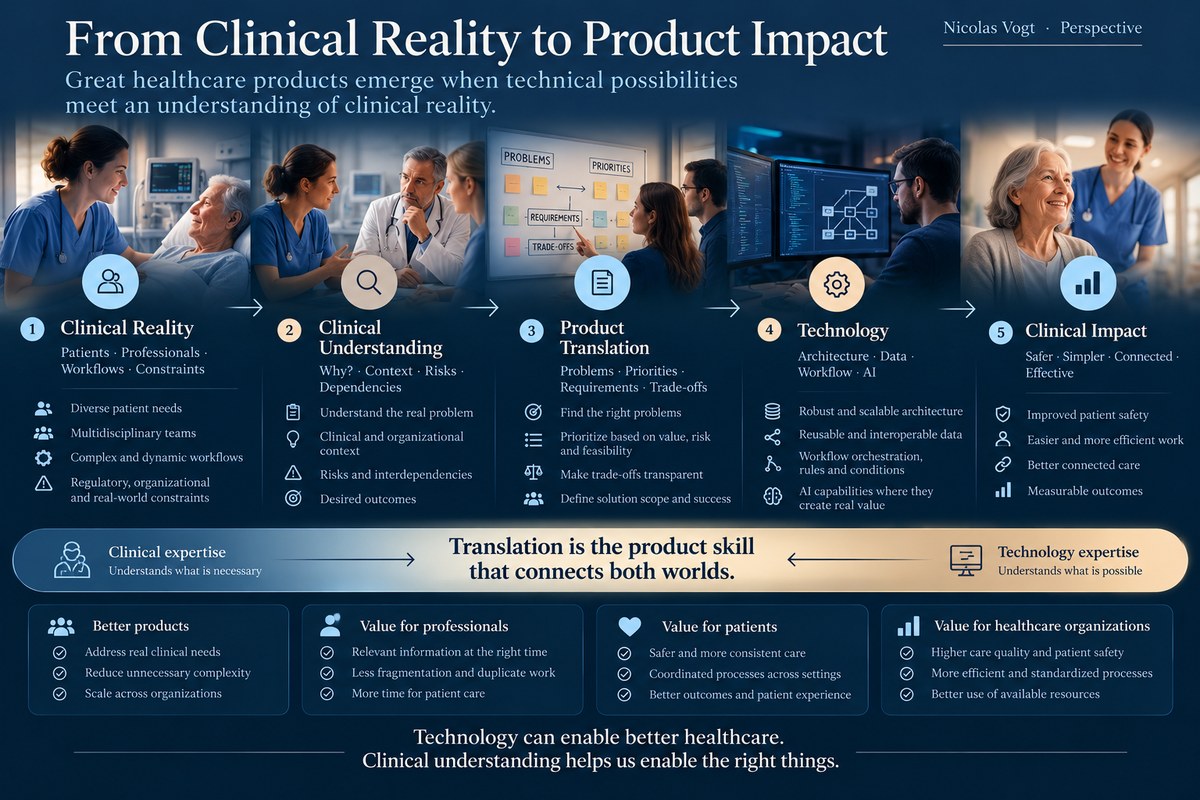
Healthcare IT is a technology business operating inside a clinical system. Both parts of that sentence matter.
Technical excellence is essential: architecture, performance, security, interoperability and maintainability determine whether a product can scale. But a technically elegant solution can still fail if it misunderstands clinical work.
Domain knowledge changes the questions
Clinical experience helps reveal details that are difficult to see from requirements alone: interruptions, handovers, professional boundaries, time pressure, exceptions and the difference between a documented process and the process that actually happens.
That does not mean every Product Manager or developer needs to be a clinician. It means product organizations need reliable ways to bring domain expertise into discovery and decision-making.
Domain expertise is not a substitute for product thinking. It makes product thinking more precise.
Technology also challenges clinical assumptions
The relationship works in both directions. Clinical expertise should not be used to preserve every established workflow. Technology creates opportunities to remove duplication, connect information and redesign processes that developed around limitations which may no longer exist.
The productive tension matters
The strongest healthcare products emerge when clinical, product and technical perspectives challenge each other constructively. Clinical reality prevents abstraction from becoming detached from users. Technology prevents domain expertise from becoming an argument for the status quo. Product Management connects both to value and direction.
My own path from clinical practice into Healthcare IT is one reason I find this intersection so important. I do not see the two worlds as opposites. The interesting work happens between them.
These notes reflect how I think about Healthcare IT, Product Management and clinical digitalization. They are personal perspectives — intended to contribute to professional discussion, not to present universal answers.